Heart Valve Replacement vs Repair: How Doctors Decide
By VNR Medical Service Editorial Team · Reviewed in line with our Medical Review Policy · June 20, 2026
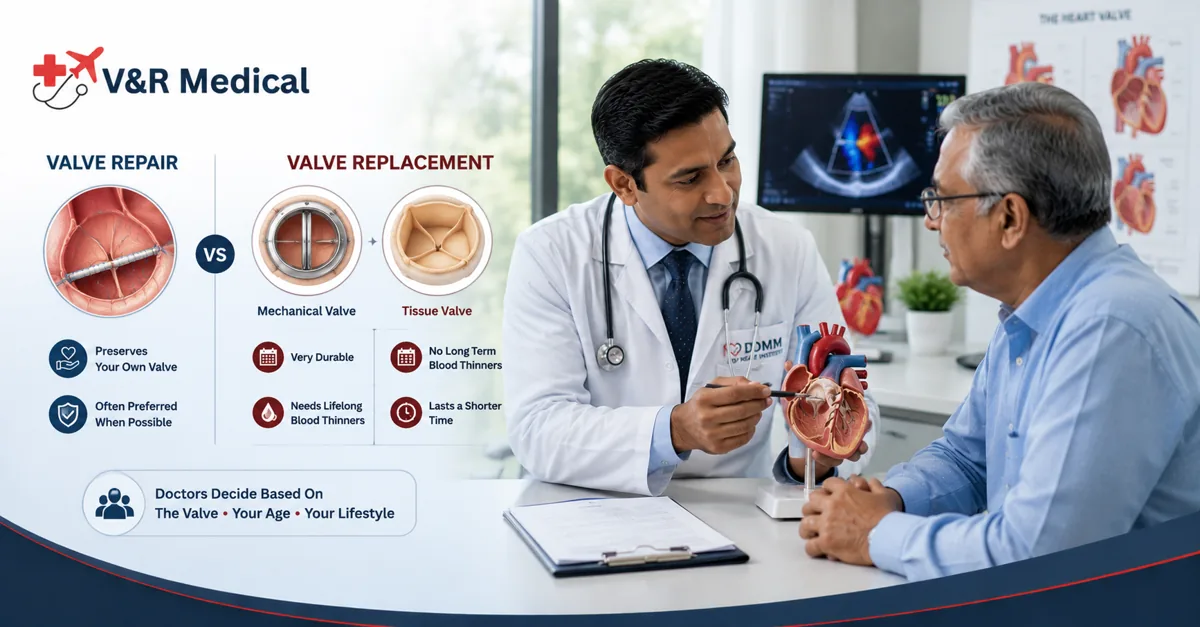
Valve repair fixes your own heart valve and is often preferred when possible, especially for leaking mitral valves, because it preserves the natural valve. Valve replacement swaps a badly damaged valve for a mechanical valve, which is very durable but needs lifelong blood thinners, or a tissue valve, which usually does not need long term blood thinners but lasts a shorter time. The heart team chooses based on the valve, your age and your lifestyle.
When a heart valve is damaged, one of the first questions patients ask is whether it can be fixed or whether it needs to be replaced. Both valve repair and valve replacement are excellent, well established treatments, and the right choice depends on which valve is affected, the type of damage, and the individual patient. This guide explains the difference between heart valve replacement and repair, the types of replacement valves, and how doctors decide.
A quick recap on heart valves
The heart has four valves that keep blood flowing in one direction. When a valve becomes narrowed or leaky, as described in our guide to heart valve disease, the heart works harder and symptoms such as breathlessness and fatigue develop. When the problem is significant, the valve is treated either by repairing it or by replacing it, as set out on our heart valve replacement and repair page.
Valve repair
Valve repair means fixing your own valve rather than removing it. Surgeons use a range of techniques, such as reshaping the valve, repairing torn supports or fitting a supportive ring, to restore normal function. Repair is most often possible for leaking mitral valves, and when it can be done it has clear advantages. It keeps your natural valve, often avoids the need for lifelong blood thinning medication, and tends to preserve heart function well. For these reasons, surgeons generally try to repair a valve whenever it is feasible and durable.
Valve replacement
When a valve is too damaged or calcified to repair reliably, which is common with severe aortic stenosis, it is replaced. The diseased valve is removed and a new one is fitted in its place. There are two main types of replacement valve, and the choice between them is one of the most important decisions in valve surgery.
Mechanical valves
Mechanical valves are made from durable man made materials and can last a lifetime, which makes them attractive for younger patients. The trade off is that they require lifelong blood thinning medication to prevent clots forming on the valve, along with regular blood tests to keep the dose correct. For someone able and willing to manage this, a mechanical valve offers excellent long term durability.
Tissue valves
Tissue valves, also called bioprosthetic valves, are made from specially treated animal tissue. Their main advantage is that they usually do not require lifelong blood thinners, which suits older patients and those who cannot take such medication. The trade off is that they do not last as long as mechanical valves and may eventually need replacing. They are often chosen for older patients, for whom durability over many decades is less of a concern.
What about TAVI?
For some patients, particularly older people or those at higher surgical risk, an aortic valve can be replaced through a catheter without open surgery, a procedure called TAVI or TAVR. A tissue valve is delivered through a blood vessel and positioned inside the old valve. It is a major advance for selected patients, and suitability is decided by the heart team after reviewing your scans and overall health.
How do doctors decide between repair and replacement?
The decision is individual and is made by the heart team after studying your echocardiogram and other tests. Key factors include which valve is affected and the nature of the damage, since some valves and some types of damage are far more repairable than others. Your age matters, because durability and the ability to manage blood thinners differ across the valve types. Your lifestyle, other health conditions, and your own preferences after a full discussion all play a part. The American Heart Association stresses that this should be a shared decision between you and your heart team.
Recovery after valve surgery
Recovery depends on the procedure. A catheter based valve replacement often has a quick recovery, while open valve surgery involves a few days in hospital, including intensive care, followed by several weeks of recovery. Most patients feel a clear improvement in breathing and energy once the faulty valve is corrected. International patients usually plan to stay in India for a few weeks to cover treatment and early recovery before flying home.
How VNR Medical Service helps
VNR Medical Service helps international patients access expert valve repair and replacement at the NABH accredited DDMM Heart Institute in India. We coordinate your free report review, an indicative cost estimate, medical visa support, travel, treatment and a safe, fit to fly return. To understand which option may suit you, send your echocardiogram for review or contact our coordination team.
Life after valve surgery
Most people return to a full and active life after valve repair or replacement, including work, travel and exercise, once their cardiologist confirms they are ready. If you have a mechanical valve, taking your blood thinning medication exactly as prescribed and attending regular blood tests is essential to keep the valve working safely. If you have a tissue valve, no long term blood thinner is usually needed, but follow up scans monitor the valve over the years. Whatever the valve, looking after your general heart health, with a good diet, regular activity and not smoking, protects your result. Long term follow up keeps your care on track, and sharing your reports with your local doctor after you return home keeps everything joined up.
Can a repaired or replaced valve last a lifetime?
How long a valve treatment lasts depends on the type. A well repaired valve can function for many years, and because it is your own tissue it often holds up well. Mechanical replacement valves are designed to last a lifetime, which is why they are favoured for younger patients willing to take blood thinners. Tissue valves are durable but not permanent, and may eventually wear out and need replacing, which is why they are often chosen for older patients. Whichever route is taken, regular follow up with echocardiograms keeps watch on the valve over the years, so that any change is picked up early and managed in good time.
What to expect in the first weeks of recovery
In the early weeks after valve surgery, rest and gentle movement go hand in hand. Your team will guide you on wound care, medicines and how quickly to build up activity. Tiredness is normal at first and improves steadily. Most patients notice that breathing and energy are already better than before surgery, because the heart is no longer fighting a faulty valve. International patients usually remain in India for this early recovery period before being cleared as fit to fly, and VNR coordinates comfortable accommodation and follow up appointments throughout the stay.
Related pages
Common Questions
FAQs
When a valve can be repaired durably, repair is often preferred because it keeps your natural valve and usually avoids lifelong blood thinners. When a valve is too damaged, replacement is the safe and effective choice. The heart team decides based on your scans.
A mechanical valve is very durable and can last a lifetime but requires lifelong blood thinning medication. A tissue valve usually does not need long term blood thinners but lasts a shorter time and may eventually need replacing. Age and lifestyle guide the choice.
There is no single best valve. Younger patients who can manage blood thinners often suit a durable mechanical valve, while older patients often suit a tissue valve that avoids long term blood thinners. Your heart team will recommend based on your valve, age and preferences.
Yes. VNR Medical Service coordinates valve repair and replacement, including catheter based options where suitable, for international patients at the NABH accredited DDMM Heart Institute. Start with a free review of your echocardiogram for an indicative estimate.
Send us your cardiac reports. We reply within 48 hours.
Free clinical review by the DDMM cardiac team. No obligation. Our international patient coordinators reply 7 days a week.